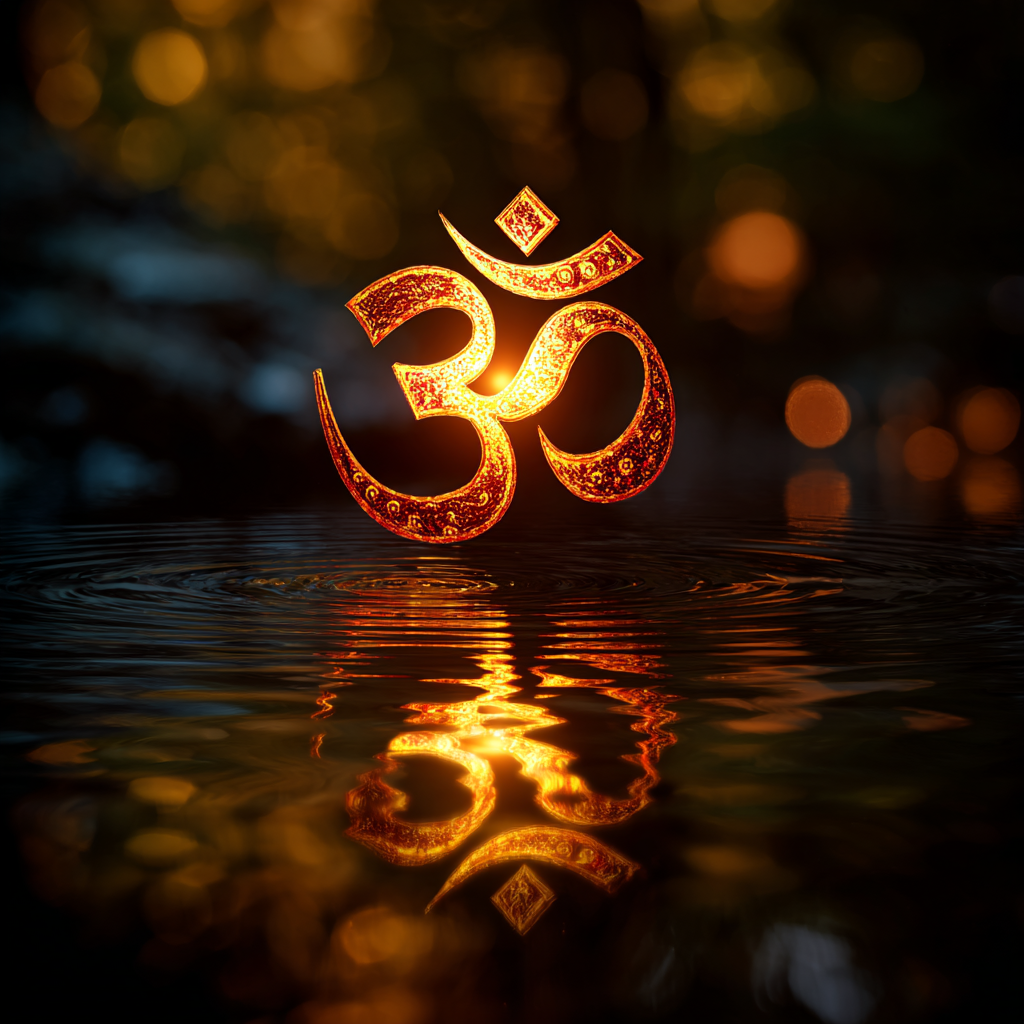
In the beginning, there was neither existence nor non-existence. There was no sky, no air, no death, no immortality. There was only the One, breathing, without breath, by its own impulse. In the infinite, silent darkness, a golden womb floated upon the cosmic waters. This was Hiranyagarbha, the Golden Egg.
From the desire of the One, a great heat was born. Within that golden egg, the seed of all creation stirred. For a thousand celestial years, it gestated in the primal waters, until the egg split with a sound that was the first vibration of the universe—the sacred syllable ॐ (Om).
From the two halves of the shell emerged the heavens and the earth. From the essence within emerged everything that is: the sun and moon from the eyes, the wind from the breath, the space from the navel, the directions from the ears. The gods, the demons, humans, animals, and plants—all life in its infinite variety—sprang forth from the body of the cosmic being.
But this was not a single event. Time in Hinduism is cyclical, without beginning or end. The universe is created, sustained, and dissolved in an endless rhythm, like the inhale and exhale of the divine.
The creator, Lord Brahma, emerges from a lotus that grows from the navel of Lord Vishnu, who rests upon the serpent Shesha in the cosmic ocean. Brahma’s single day, called a Kalpa, lasts 4.32 billion human years. During this day, the universe exists. When Brahma sleeps at night, the universe is withdrawn back into Vishnu, only to be created anew with Brahma’s next dawn.
Thus, the origin is not a point in a linear past, but a perpetual dance of emergence, order, and graceful dissolution—the divine play of the Trimurti: Brahma the Creator, Vishnu the Preserver, and Shiva the Destroyer, who makes way for new beginnings. The universe breathes, and we are within its breath.