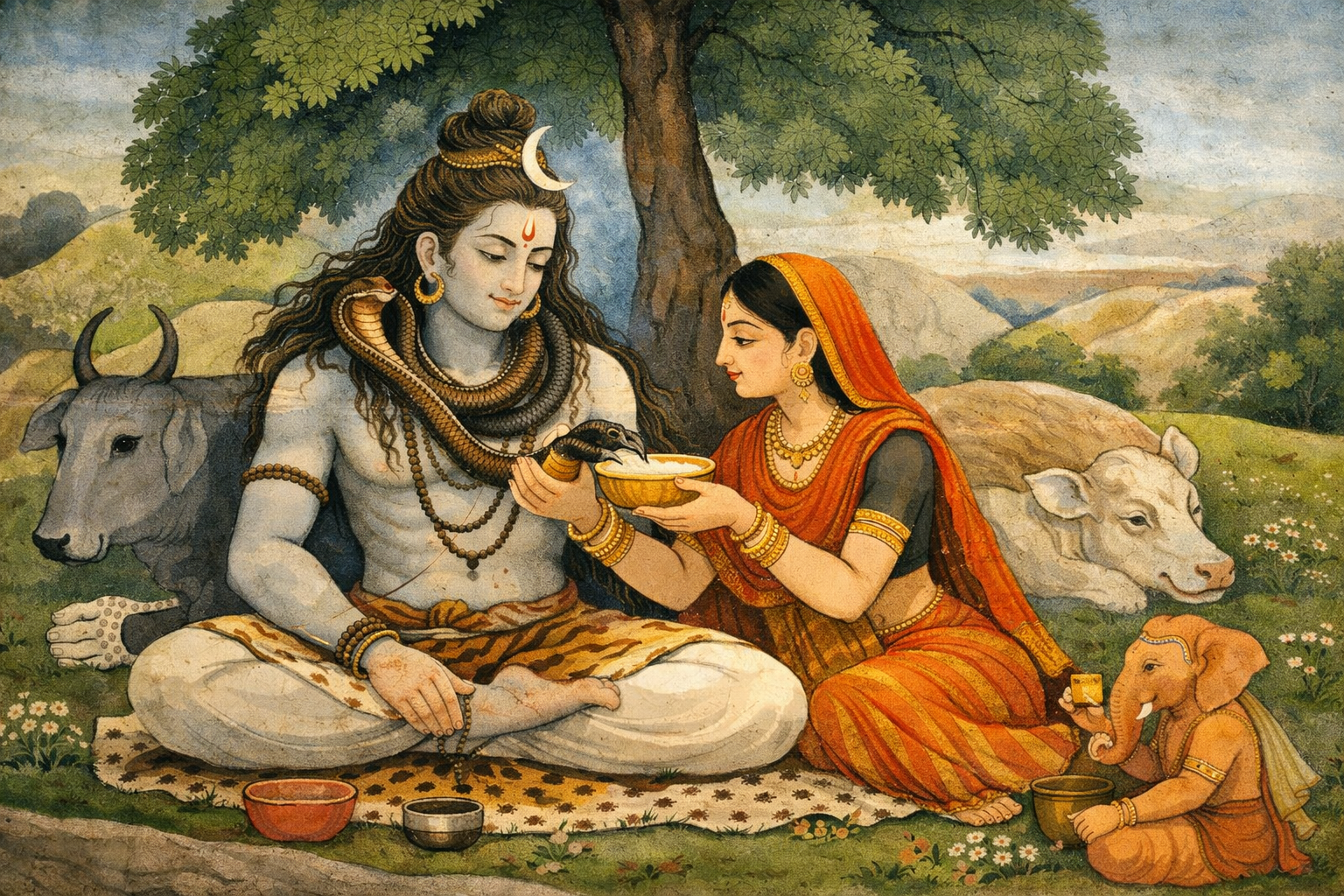
Short, powerful explanation (voiceover-ready):
Shiva is simple because he wants nothing.
No palace. No crown. No riches.
He lives in silence, on a mountain, with ash on his skin.
His ornaments are a snake, his clothes are ashes,
his home is the Himalayan cave,
his wealth is stillness.
Shiva doesn’t ask for grand rituals—
a leaf, a drop of water, a sincere heart is enough.
He teaches that true power is not in owning more,
but in needing less.
That’s why Shiva is simple:
because he is complete within himself.
Shiva is often described as extremely simple — in fact, among the major Hindu deities, he is frequently called the simplest and easiest to approach.
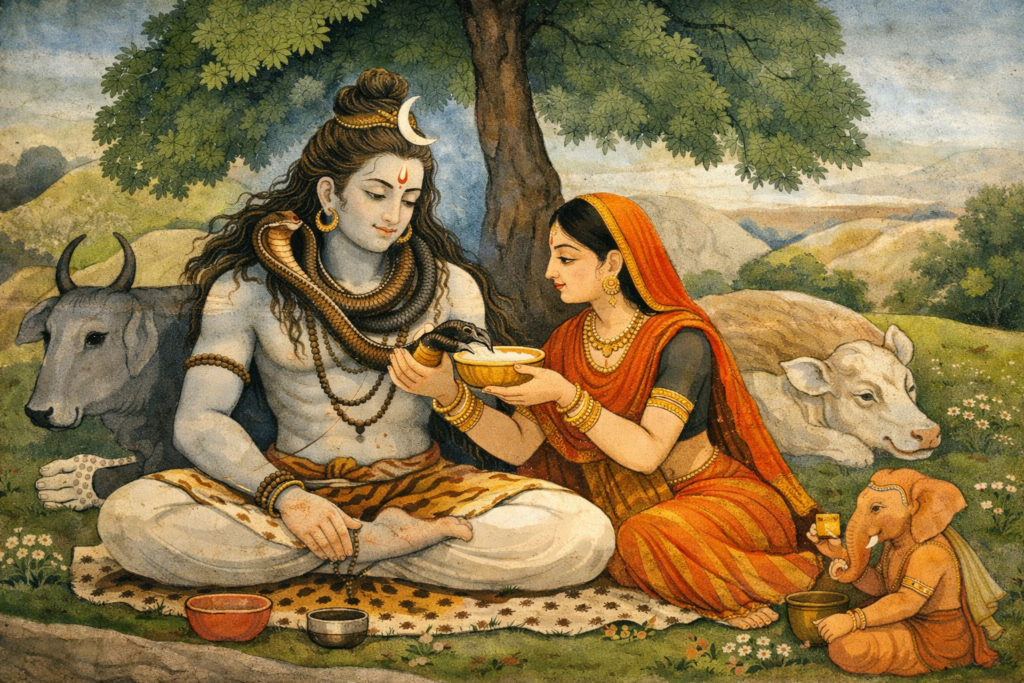
This comes through most clearly in his popular name Bholenath (भोलेनाथ) — “the innocent/simple Lord” or “the guileless one.” Devotees emphasize this aspect again and again:
- He is pleased very easily (Ashutosh / Āśutoṣa — “quickly satisfied”).
A genuine leaf (bilva patra), a little water poured with devotion, even just sincere chanting of “Om Namah Shivaya” — or sometimes nothing elaborate at all — is enough to melt him. Stories abound where demons, outcasts, or simple villagers receive boons instantly because their heart was true, while more ritual-heavy paths for other deities can feel complex or conditional. - His lifestyle is the picture of radical simplicity:
- Lives on snow-covered Kailash with almost nothing
- Wears tiger/leopard skin, smears ash on his body
- No palaces, no jewels, no armies — just a trident, a drum, a snake around his neck, and matted hair
- Detached from worldly wealth (he even gave everything material to Parvati)
- Worship is straightforward: no need for priests in many cases, no strict vegetarian rules for devotees in some traditions, no elaborate altars required. A small lingam under a tree, or even mentally, works.
This simplicity is why millions feel an immediate, childlike connection to him — he’s not distant royalty (like some depictions of Vishnu/Krishna in opulent Vaikuntha), but the approachable yogi who sits with ascetics, ghosts, and ordinary people alike.
Yet — and this is the beautiful twist that keeps coming up — this very simplicity hides infinite depth.
The one who seems so easy and innocent is simultaneously the most transcendent, the destroyer of universes, the non-dual consciousness beyond all categories. So devotees say:
“To the mind he looks infinitely complex… but to the heart he is the simplest thing in existence.”
In practice, many people find Shiva devotion feels lighter and less rule-bound than some other paths precisely because of this Bholenath quality.
So, how simple is Shiva?
On the level of bhakti (devotion) and approachability → extremely simple, perhaps the simplest.
On the level of ultimate reality/philosophy → he points straight to the simplest truth of all: pure being, without complications.
Which side resonates more with you right now — the easy-to-please Bholenath, or the one who dissolves everything into pure simplicity? 😊