In Hindu cosmology, the creation of life is a cyclical and purposeful process, described in various Puranas and scriptures. According to these texts, the universe undergoes repeated cycles of creation, preservation, and dissolution. The creation of animals and birds is intricately linked to the emergence of different life forms from the Supreme Consciousness.
One of the primary accounts comes from the Vishnu Purana and Matsya Purana. It is said that after the great dissolution (Pralaya), Lord Brahma, the creator, emerges from a lotus stemming from the navel of Lord Vishnu, who rests upon the cosmic serpent Shesha in the ocean of causality. Brahma then begins the work of creation.
The process is often described as unfolding in stages:
- The Emergence of the Five Elements (Pancha Mahabhutas): First, the five gross elements—space (akasha), air (vayu), fire (agni), water (jala), and earth (prithvi)—manifest from the divine will.
- The Three Qualities (Gunas) and the First Beings: From these elements, the three gunas (modes of material nature)—sattva (purity), rajas (passion), and tamas (ignorance)—combine in different proportions to create various life forms. It is important to note that in many accounts, humans are not created before animals and birds in a linear sense; rather, different types of beings manifest simultaneously or in a complex hierarchy of consciousness. A common narrative states that Brahma first created divine beings and sages from the sattvic parts of his being. Then, from the mode of tamas (darkness, inertia), the animals, birds, and other creatures were manifested. They embodied instinct, desire, and a more embedded connection to the material world.
- Specific Creation Stories:
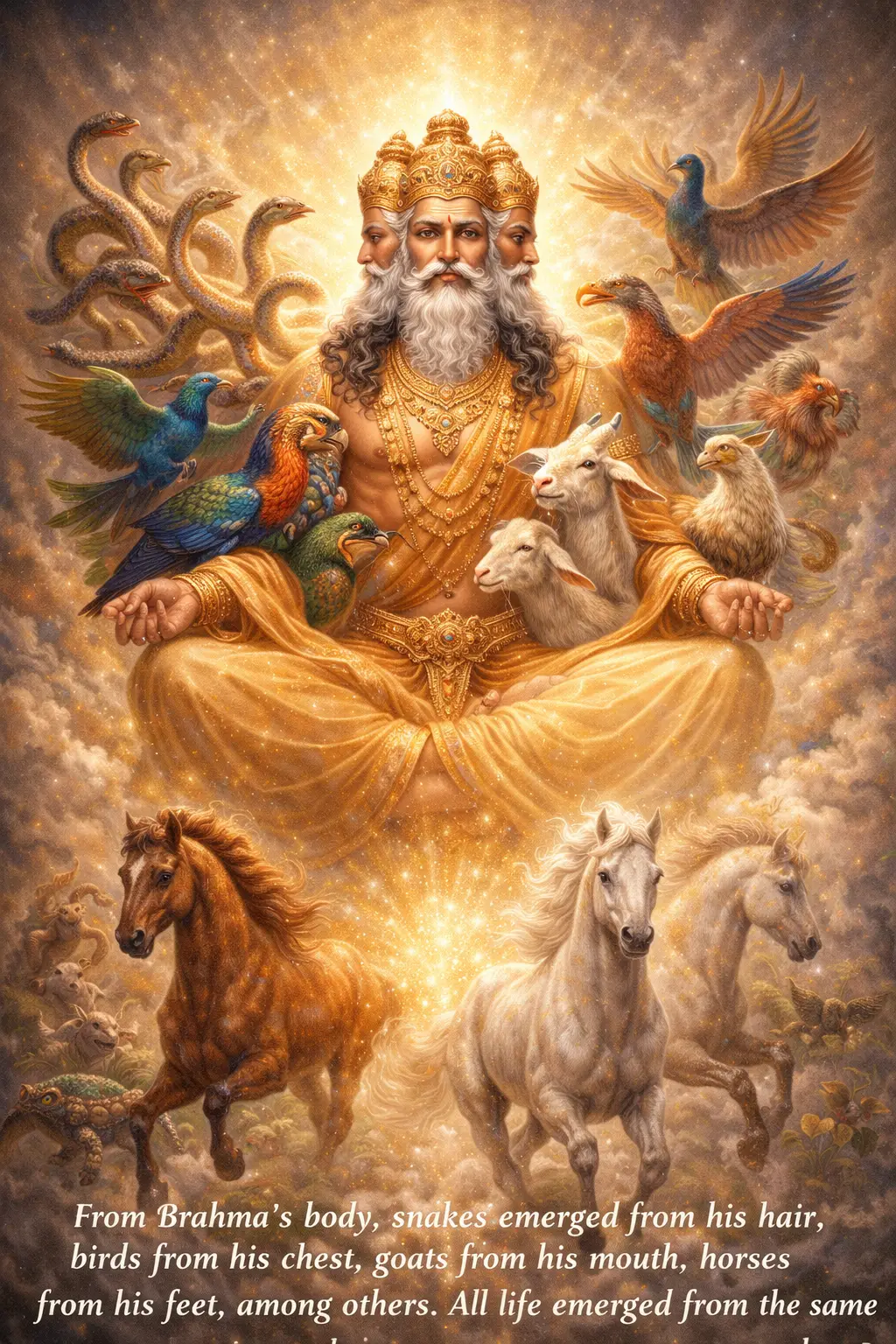
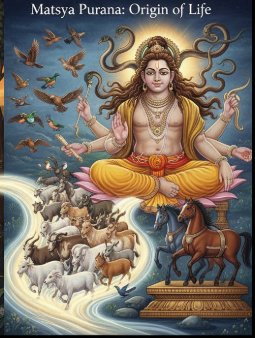
- The Matsya Purana describes that from Brahma’s body, different creatures emerged: snakes from his hair, birds from his chest, goats from his mouth, and horses from his feet, among others. This symbolizes that all life originates from the same divine source.
- Another concept is that of Yajna (Sacrifice): The Purusha Sukta hymn in the Rig Veda describes the cosmic being, Purusha, whose self-sacrifice gives rise to all of creation. From different parts of his body, the four social orders (varnas), the sun, the moon, the atmosphere, and also animals were born. Specifically, horses and cattle are said to have come from his chest and abdomen.
- The Bhagavata Purana details successive “births” of life. After the elements, the total cosmic intelligence (mahat-tattva) appears, followed by false ego (ahankara). From the ego in the mode of tamas, the sense organs and the subtle elements are born. From these, the gross bodies of immobile beings (plants) and mobile beings (animals, birds, humans, etc.) are formed.
- The Role of Karma and Rebirth: A crucial aspect of Hindu thought is the cycle of samsara (rebirth). The form a soul takes—whether as a bird, animal, human, or divine being—is determined by its karma (the accumulated results of its past actions). A soul can incarnate into an animal or bird body based on its previous desires, attachments, and ignorance. Conversely, an animal, by living according to its innate dharma (duty/purpose), can progress to a human birth in a future life, which is considered a rare opportunity for spiritual liberation (moksha).
In essence, according to Hinduism:
- Animals, birds, humans, and all beings are manifestations of the same divine essence (Brahman), clothed in different forms based on the interplay of the three gunas.
- Creation is not a one-time event but a continuous, cyclical process governed by divine will and cosmic law.
- The hierarchy of life is not static but fluid, governed by the law of karma and rebirth. The human form is a privileged station for self-realization, but it exists within a vast, interconnected web of life that includes all creatures, each with its own purpose (svadharma) in the cosmic order.
Thus, animals and birds are not “created after humans” in a simple timeline, but are co-participants in the eternal drama of creation, each playing a role in the balance of the cosmos and the journey of the soul.