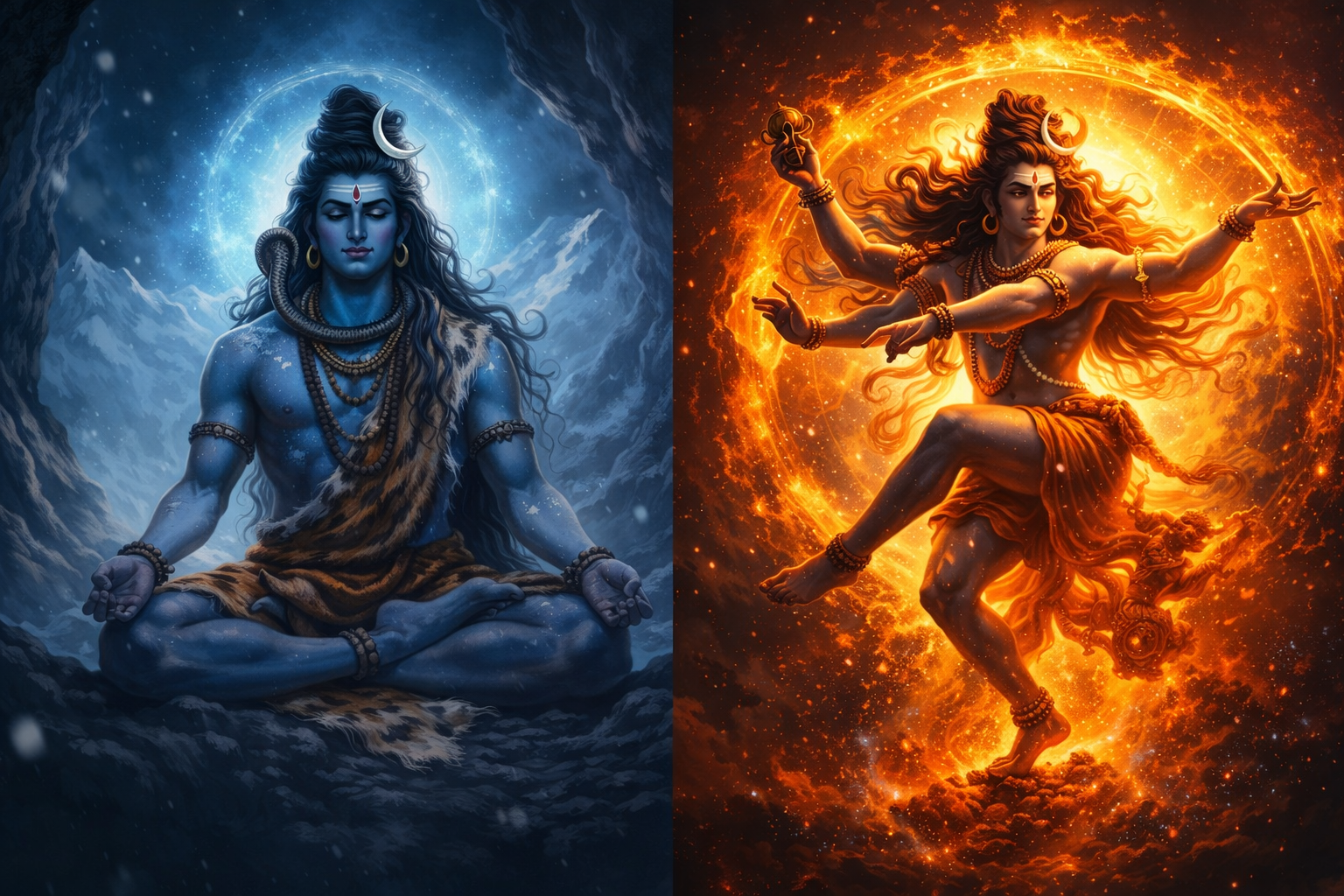
Shiva is not one thing. He is many opposites living in one form.
- Destroyer & Protector – He dissolves illusion, not the world.
- Wild Ascetic & Loving Householder – A meditating yogi in the Himalayas, yet a devoted husband to Parvati and father to Ganesha & Kartikeya.
- Fierce & Compassionate – Can open the Third Eye in rage, yet drinks poison to save the cosmos.
- Cosmic Dancer & Still Meditator – Creates rhythm as Nataraja, rests in silence as Adiyogi.
- Formless & Formed – Worshipped as the Shiva Lingam (pure consciousness) and as a personal deity with stories and emotions.
That’s why Shiva is complex:
He represents the full spectrum of human and cosmic experience—anger and mercy, silence and sound, destruction and rebirth.
Shiva isn’t about perfection. He’s about transformation.
Shiva is widely regarded as one of the most complex deities in Hinduism — many scholars, devotees, and texts describe him as the most paradoxical and multifaceted figure in the entire pantheon.
His complexity arises from several layers that coexist without contradiction in Hindu thought:
- Extreme paradoxes in personality and role
He simultaneously embodies:
- The ultimate ascetic yogi (detached, meditating on Mount Kailash, smeared in ash, celibate)
→ and the passionate householder (married to Parvati, father of Ganesha & Kartikeya, romantic/fertile) - The terrifying destroyer (fierce Rudra/Bhairava forms, burning Kama to ash, dancing the cosmic dissolution Tandava)
→ and the supremely merciful & benevolent (Bholenath – the innocent/one who is easily pleased, quick to forgive and grant boons) - The erotic & sexual (Ardhanarishvara half-male half-female form, lingam worship)
→ and the completely transcendent & formless (often equated with attributeless Brahman or śūnya/pure void-like consciousness) Britannica and many philosophers explicitly say his character reconciles “semantically opposite though complementary aspects” to the point that it can seem incomprehensible from a human standpoint.
- Cosmic roles
In the Trimurti he’s “just” the Destroyer, but in Shaivism (where he is the Supreme Being) he performs all five acts (pañcakṛtya in many traditions):
- Creation (sṛṣṭi)
- Preservation (sthiti)
- Destruction/dissolution (saṃhāra)
- Concealment/veiling (tirodhāna)
- Grace/revelation (anugraha) Some Shaiva systems map him onto the entire 25 tattvas (principles) of Sāṃkhya philosophy.
- Philosophical depth
Different Shaiva schools present dramatically different views of him:
- Dualistic / theistic (Shaiva Siddhanta) → personal Lord distinct from souls
- Non-dual monistic (Kashmir Shaivism / Trika) → pure consciousness (Cit), identical with the Self, Shakti, and the universe (everything is Shiva manifesting)
- Transcendent “nothingness” (not nihilism, but beyond all categories – formless, infinite, śūnya yet absolutely full) This range makes Shiva simultaneously the most personal god (quick to melt at true devotion) and the most abstract metaphysical principle.
In short:
If Vishnu is often experienced as loving-preserver and Brahma as creator (more straightforward roles), Shiva is routinely called the most mysterious, most paradoxical, and most difficult to fully grasp Hindu deity — even by his own ardent devotees.
Many say you don’t really “understand” Shiva intellectually; you eventually dissolve into the experience of him.
That’s why the question “how complex is Shiva?” often gets the half-joking devotee answer: infinitely complex — because he ultimately points beyond complexity itself. 😄
What aspect draws you most — the myths, the philosophy, the symbolism, or something else?