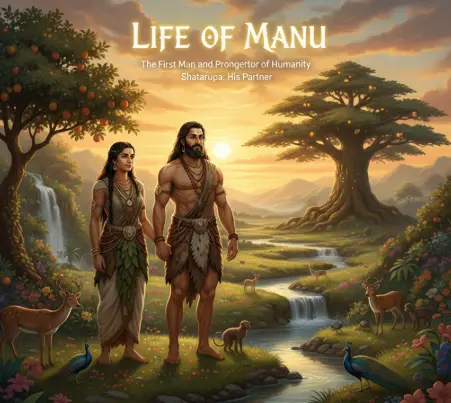
In the beginning, there was only the cosmic ocean, and upon it, the desire of the Absolute to know itself. From this desire, the first mind was born—Manu, the progenitor, the archetype of humanity. He awoke not to a world, but to a vast and silent potential, cradled in the golden egg of creation. His consciousness was the first spark in the void, a lonely beacon of thought and feeling.
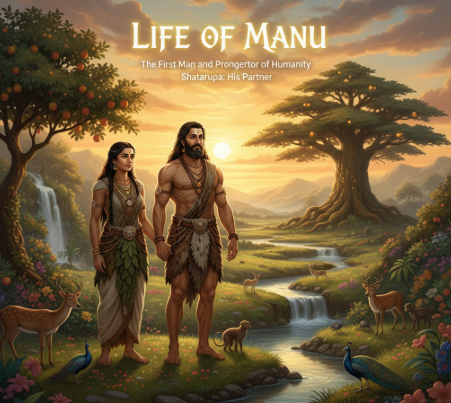
And the Absolute saw that Manu was alone. From the very essence of his being, from his own longing for reflection and connection, the divine will manifested Shatarupa. She arose not as a separate creation, but as the other half of his own soul, the embodiment of all the beauty, grace, and creative energy that lay dormant within him. Her name meant “she of a hundred beautiful forms,” and in her eyes, Manu saw not just a companion, but the entire universe made manifest in a single, compassionate gaze.
Together, they were given the sacred charge: to become the seeds of the human race. The empty world was their canvas. Manu, with his capacity for logic, order, and protection, named the stars and charted the paths of rivers. Shatarupa, with her intuition, nurturing spirit, and artistic vision, filled those rivers with song and made the stars dance with stories. She taught the vines to climb and the flowers to bloom in a riot of color; he learned to build shelter from their whispers and predict the seasons from their cycles.
Their life was not one of idle paradise, but of profound partnership. They learned from each other. Manu’s strength provided safety, allowing Shatarupa’s creativity to flourish. Shatarupa’s empathy softened Manu’s resolve, teaching him compassion. When doubt clouded his mind, her faith was his clarity. When sorrow touched her heart, his steadfastness was her solace.
Their love was the first prayer, their union the original ritual. From this sacred bond, children were born—not just offspring, but the diverse lineages of humanity, each carrying a spark of Manu’s consciousness and a facet of Shatarupa’s form. He taught them the laws of duty, justice, and survival. She taught them the arts of love, music, and the recognition of the divine in all things.
In time, as the world grew populated with their descendants, the first couple’s physical forms withdrew. But they did not vanish. Manu became the eternal principle of the mindful human spirit, the inner guide that urges us toward structure, purpose, and perseverance. Shatarupa became the everlasting essence of the soul’s beauty, the creative and sustaining force that lives in every act of kindness, every work of art, and every selfless love.
They are remembered not as distant gods in a forgotten myth, but as the primordial parents whose intertwined spirits live within every human heart. Manu is the question we ask of the world; Shatarupa is the feeling with which we answer it. And humanity itself is their ongoing story, a testament to the first and most powerful truth: that we are born from, and forever yearn for, the sacred union of consciousness and compassion.