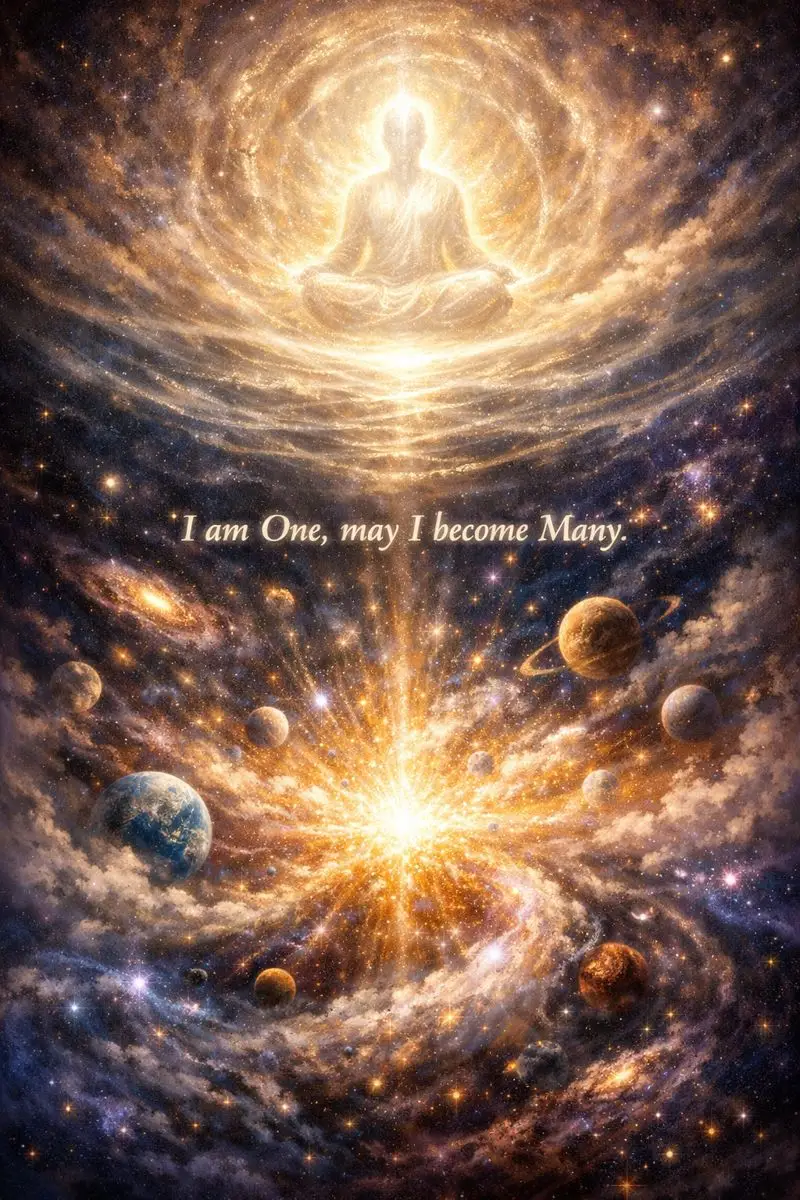
In the beginning, there was only Brahman—the supreme, formless, infinite reality. From the stillness of Brahman arose a vibration, a desire: “I am One, may I become Many.” This was the first thought, and from it, the universe was born.
According to the ancient hymns of the Rigveda, the earliest scriptures of Hinduism, the origin of humans is a cosmic mystery. One profound hymn describes a great Cosmic Sacrifice (Purusha Sukta). The universe itself is envisioned as a primordial giant, Purusha, with a thousand heads, eyes, and feet, pervading all space. The gods performed a sacred ritual, sacrificing this cosmic being. From his body, all of creation emerged:
- From his mind came the Moon.
- From his eyes, the Sun.
- From his breath, the Wind.
- From his navel, the Atmosphere.
- From his head, the Heavens.
- From his feet, the Earth.
And crucially, from different parts of Purusha, human society was formed:
- From his mouth came the Brahmins (priests, teachers).
- From his arms came the Kshatriyas (warriors, rulers).
- From his thighs came the Vaishyas (merchants, farmers).
- From his feet came the Shudras (laborers, service providers).
This symbolizes not a hierarchy of birth, but an interconnected, organic whole where every part of society is essential and divine in origin.
Another central narrative comes from the Puranas, the great mythologies. Here, the task of creation is given to Lord Brahma, the creator aspect of the divine trinity (with Vishnu the preserver and Shiva the destroyer).
In the current cycle of creation, Brahma, seated on a lotus that grew from the navel of Lord Vishnu, began his work. He first created mind-born sons, the great sages like Sanaka, Sanandana, Sanatana, and Sanat Kumara, from his thoughts. However, these sages were devoted to eternal celibacy and meditation, so they did not procreate.
Frustrated, Brahma’s intense concentration split his own form. From his divided self emerged Shatarupa (she of a hundred forms), the first woman, also known as Saraswati, the goddess of knowledge. Brahma was captivated by her beauty. From their union—manifesting in various forms and through various means—came Manu, the first man and progenitor of humanity, and Shatarupa as his partner.
Manu, whose name is the root for the word “man” (manava), is thus considered the father of the current human race. His story is told in the epic flood narrative, similar to many ancient cultures, where he is warned by Lord Vishnu (in the form of a fish) to build a great ark to preserve life, thus ensuring the continuity of humanity.
The Deeper Essence: The Atman
Beyond these cosmic and mythological origins lies the core philosophical truth of Hinduism regarding humans. Every living being, especially humans, carries within a spark of the divine—the Atman (the individual soul). This Atman is eternal, indestructible, and ultimately identical with Brahman, the universal soul.
Therefore, the human origin is not merely a physical event from a cosmic giant or a primal father. It is a spiritual descent. We are divine consciousness, cloaked in layers of mind and matter (prakriti), born into the cycle of life and death (samsara) to experience, learn, and ultimately realize our true nature. A human birth is considered rare and precious, as it provides the self-awareness and intellect necessary to pursue Moksha—liberation from the cycle and union with the divine.
In essence, Hinduism presents a multi-layered origin: a cosmic sacrifice that establishes the interconnectedness of all life, a mythological lineage from the creator Brahma and the progenitor Manu, and a profound spiritual truth that every human is, at the core, a fragment of the infinite divine, on a journey back to its source.