
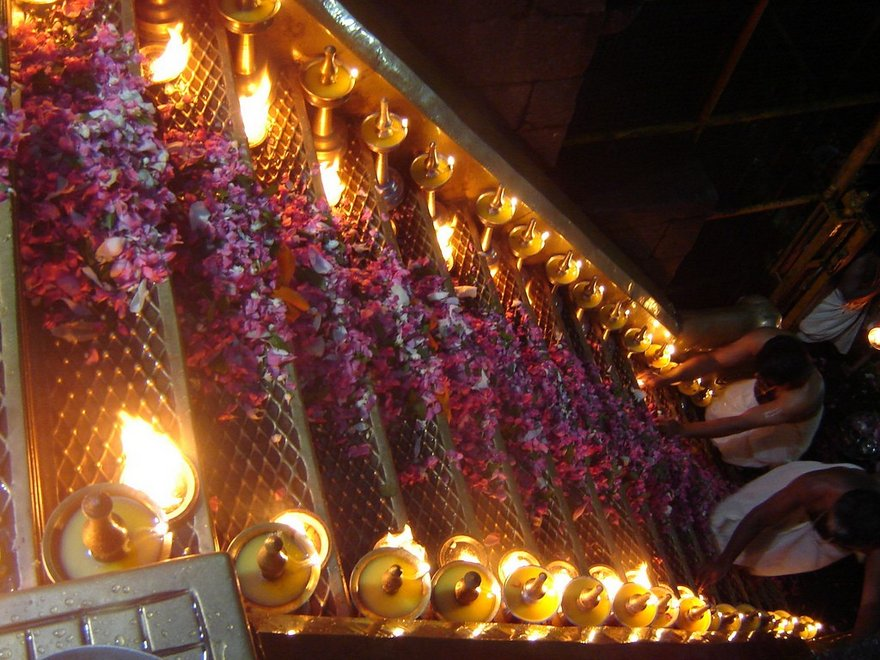
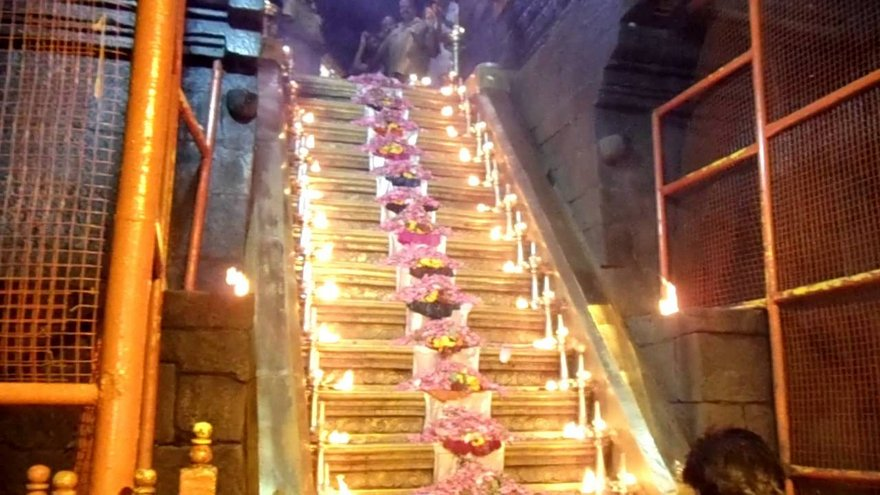
Before one views the Sanctum Sanctorum, one has to climb over eighteen sacred steps. These steps are now covered with `Panchaloham’ ( A Special Composition of gold, silver, copper, iron and tin ). Pilgrims initiate their ascent up the Pathinettam Padi by placing their right foot on the first step.
The symbolism of these 18 steps is as follows:-
The first five steps symbolise the five human senses (Panchendriyas).
1. Visual (Eye)
2. Auditory (Ears)and
3. Olfactory (Nose)
4. Gustatory (Tongue)
5. Tactile (Skin)
The next eight steps symbolise the eight Ashtaragas.
6. Kama (Love)
7. Krodha (Anger)
8. Lobha (Avarice)
9. Moha (Lust)
10. Madha (Pride)
11. Maltsarya (Unhealthy Competition)
12. Asooya (Jealous)
13. Dhumb (Boastfulness)
The next three steps stand for three Gunas or Thrigunas (Nature-born qualities).
14. Satva (Perspicuity, Discernment)
15. Rajas (Activity, Enjoyment)
16. Thamas (Inactivity, Stupor)
The last two steps represent:
17. Vidya (Knowledge)
18. Avidya (Ignorance)
The Deep Symbolism: Why Number 18?
The number 18 is highly significant in Hinduism (e.g., 18 chapters in the Gita, 18 Puranas, 18 days of the Kurukshetra war). At Sabarimala, the consensus is that climbing these steps represents conquering different facets of human existence to attain self-realization.
While there are varying interpretations, the most widely accepted spiritual view is that the steps represent ascending levels of consciousness:
A. Conquering the Self (The First 13 Steps)
The journey begins by transcending one’s own physical and mental limitations.
The 5 Indriyas (Sense Organs): Steps 1-5 represent conquering sight, hearing, smell, taste, and touch.
The 5 Karmendriyas (Organs of Action): Steps 6-10 represent mastering the hands, feet, mouth, reproductive, and excretory organs.
Conquering Worldly Perception (The Next 5 Steps)
Once the inner self is mastered, the devotee must transcend how they interact with the outer world.
The 3 Mental Aspects (The Inner Instrument): Steps 11-13 represent transcending the Manas (mind/emotion), Buddhi (intellect), and Ahankara (ego).
The 3 Gunas (Nature’s Qualities): Steps 14-16 represent rising above Sattva (goodness/harmony), Rajas (passion/activity), and Tamas (ignorance/inertia).
Ignorance and Knowledge: Steps 17-18 symbolize transcending both Avidya (ignorance) and Vidya (knowledge itself), moving into a state of pure awareness.
In Summary: When a devotee stands on the 18th step, they have symbolically left behind their worldly attachments, senses, and ego, arriving in a pure state ready to realize “Tat Tvam Asi” (Thou Art That)—the ultimate realization that the devotee and God are one.
This is a fascinating topic. In the realm of Hindu pilgrimages, few architectural elements hold as much spiritual weight as the Pathinettam Padi—the 18 Divine Steps leading to the sanctum sanctorum of Lord Ayyappa at Sabarimala.
They are not merely a staircase to gain height; they are considered a spiritual ladder. Stepping onto them is the culmination of weeks of rigorous penance and the final threshold before encountering the divine.
Here is interesting information detailing the significance, symbolism, and traditions surrounding the 18 steps of Sabarimala.
1. The Golden Rule: The “Ticket” to the Stairs
The most critical fact about the Pathinettam Padi is that not everyone is allowed to climb them.
Unlike regular temple steps, you cannot simply walk up them to see the deity. Access is strictly restricted to those devotees who carry the Irumudi Kettu on their heads.
- The Irumudi: This is a two-compartment cloth bundle containing offerings for the deity (like ghee-filled coconuts) and personal items for the traveler.
- The Significance: Carrying the Irumudi signifies that the devotee has observed the mandatory 41-day Vratham (penance/fasting), maintaining strict celibacy, austerity, and devotion.
- Note: Devotees arriving without the Irumudi Kettu must use a separate side entrance to reach the sanctum; they are forbidden from touching the 18 holy steps.
2. The Deep Symbolism: Why Number 18?
The number 18 is highly significant in Hinduism (e.g., 18 chapters in the Gita, 18 Puranas, 18 days of the Kurukshetra war). At Sabarimala, the consensus is that climbing these steps represents conquering different facets of human existence to attain self-realization.
While there are varying interpretations, the most widely accepted spiritual view is that the steps represent ascending levels of consciousness:
A. Conquering the Self (The First 13 Steps)
The journey begins by transcending one’s own physical and mental limitations.
- The 5 Indriyas (Sense Organs): Steps 1-5 represent conquering sight, hearing, smell, taste, and touch.
- The 5 Karmendriyas (Organs of Action): Steps 6-10 represent mastering the hands, feet, mouth, reproductive, and excretory organs.
- The 3 Mental Aspects (The Inner Instrument): Steps 11-13 represent transcending the Manas (mind/emotion), Buddhi (intellect), and Ahankara (ego).
B. Conquering Worldly Perception (The Next 5 Steps)
Once the inner self is mastered, the devotee must transcend how they interact with the outer world.
- The 3 Gunas (Nature’s Qualities): Steps 14-16 represent rising above Sattva (goodness/harmony), Rajas (passion/activity), and Tamas (ignorance/inertia).
- Ignorance and Knowledge: Steps 17-18 symbolize transcending both Avidya (ignorance) and Vidya (knowledge itself), moving into a state of pure awareness.
In Summary: When a devotee stands on the 18th step, they have symbolically left behind their worldly attachments, senses, and ego, arriving in a pure state ready to realize “Tat Tvam Asi” (Thou Art That)—the ultimate realization that the devotee and God are one.
3. Other Interesting Interpretations
Besides the philosophical view above, there are other popular cultural and mythological interpretations of the 18 steps:
- The 18 Hills: Some believe the steps represent the 18 surrounding hills that Lord Ayyappa presides over in the Western Ghats region. Climbing the steps is symbolic of traversing his entire domain.
- The 18 Weapons: Ayyappa is a warrior deity. Another view is that he surrendered his 18 weapons of war on these steps before entering the sanctum of eternal peace. The devotee, too, symbolically lays down their inner “weapons” of aggression.
- The 18 Puranas: Some interpret the steps as representing the 18 main Hindu scriptures (Maha Puranas).
4. The Ritual of the Coconut
Right before placing their right foot on the first step, a devotee performs a crucial ritual: breaking a coconut.
There is a designated spot near the first step where devotees smash a coconut brought in their Irumudi. This act symbolizes the shattering of the hard outer shell of the ego (Ahankara) to reveal the pure, sweet inner self (represented by the coconut water and kernel) to the Lord.
5. Physical Transformation of the Steps
For centuries, the Pathinettam Padi were rugged, rough-hewn granite stones, worn smooth by the bare feet of millions of devotees.
- Due to significant wear and tear, in 1985, the steps were covered with Panchaloha plates (a sacred five-metal alloy of gold, silver, copper, zinc, and iron).
- Later, the steps were further covered in thick gold plating to protect them and enhance their divine sanctity.
6. The Padi Pooja
While devotees climb the steps, the steps themselves are objects of worship.
On specific days during the pilgrimage season, when the temple doors are closed to the public for the night, the Chief Priest (Tantri) performs a special ritual called Padi Pooja. Offerings, flowers, and lamps are placed on each of the 18 steps, worshipping the presiding deities of each step. It is considered a visually spectacular and highly sacred ritual.
